
Polk County Court Records After a Jail Arrest
An arrest is the start of the story, not the end. After a Polk County arrest, the person is booked into the jail, and the booking record shows the arrest charges. The court record begins later, when the State Attorney for the Tenth Judicial Circuit files formal charges. Those filed charges, the hearing dates, and the result all live in the Clerk of the Court's case file. That court file is what most people mean when they search for court records after an arrest.
The booking side and the court side answer different questions. For custody, booking dates, and bond flags, the roster on the jail inmate records page is the source, and booking photos sit on the jail roster mugshots page. The court record, by contrast, shows the charges the prosecutor actually filed and how the case moved through the system. The two can differ, because a prosecutor may file the same charges, change them, add to them, or decline to file at all.
How to Find Polk County Court Records After an Arrest
The Polk County Clerk runs the ShowCase portal for criminal and traffic cases. The Clerk's criminal and traffic records page describes what the portal holds: the progress docket, court dates, case status, filed documents such as arrest affidavits and judgments, charges, and payments. Anonymous searching is allowed, though some documents need clerk review or a registered role.
The public case search runs through the Clerk's ShowCase portal, shown below.
The portal accepts a name, a case number, or several other identifiers, then returns the matching cases.
- Open the ShowCase case search from the Clerk's site.
- Search by defendant name, or by case number if you have it. Wildcards such as SMI% are allowed.
- Open the case to read the charge list, dockets, bonds, sentences, and warrants tabs.
- Check each charge's statute, level, and current status against the booking charges.
For a statewide criminal history rather than a single county case, the Florida Department of Law Enforcement keeps the official record across all counties. The Clerk also warns that online data is public-service information, that official records sit at the courthouse at 255 N. Broadway Ave. in Bartow, and that data can change without notice. Systematic or programmatic downloading of the portal is not allowed, and some case types or documents require a registered role or clerk review before they open.
ShowCase Court Records Search Fields
The ShowCase search form takes far more than a name. The table below lists the fields most useful for finding a case that follows an arrest.
| Field Label | Type | Notes |
|---|---|---|
| Last Name / First Name | Text | Wildcards allowed, such as SMI% or JOH%. |
| Date of Birth | Date | MM/DD/YYYY format. |
| Case Number | Text | Shortcuts work without wildcards. |
| Arrest Date | Date | MM/DD/YYYY; ties the case to the arrest. |
| Booking # | Text | Format yyyy999999; links the court case to the jail booking. |
| Citation # | Text | Number without dashes or check digit. |
| Search Type | Radio | Exact, SoundEx, or Starts With. |
| Show One Row Per Case | Checkbox | Collapses duplicate rows. |
How Charges Get Filed After an Arrest
The court record opens with a charging document. After booking, the State Attorney reviews the arrest and decides what to file. Most cases move forward by information, the charging document a prosecutor files directly. A complaint or citation path covers lower-level matters, and an indictment from a grand jury is reserved for the most serious felonies. Each one starts the formal case.
| Complaint | Information | Indictment | |
|---|---|---|---|
| Filed By | Officer / Prosecutor | State Attorney | Grand Jury |
| Common For | Misdemeanors | Many felonies | Serious felonies |
| Starts | The case | The case | The case |
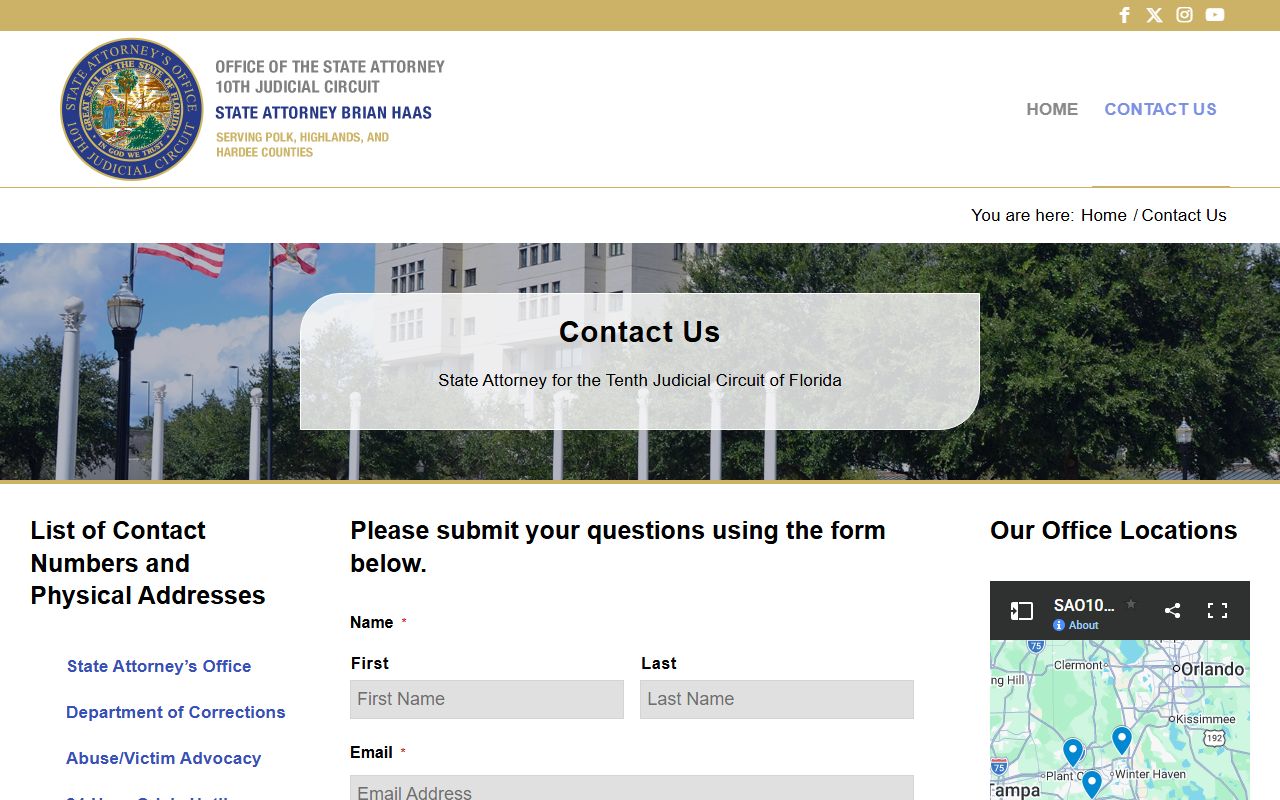
The State Attorney for the Tenth Judicial Circuit handles this charging decision for Polk, Hardee, and Highlands counties. The office reviews the arrest material, then files, amends, reduces, or declines charges. Its Polk offices include the Bartow courthouse, a Lakeland office on East Parker Street, and a Lake Alfred office, and prosecution records can be requested through the office's public-records contact. The Clerk's case file shows an SA number field, which links the court record back to the prosecutor's case.
The State Attorney's contact channels show the offices that handle Polk County prosecutions.
Note: The charges that open the court record can differ from the booking charges, because the prosecutor, not the arresting officer, decides what is filed.
Charge Status and What It Means
Charges do not stay fixed as a case moves. They can be amended, reduced, added, dropped, or dismissed, and the court record shows each change. A jail booking charge that looked serious can become a lesser filed charge, or disappear entirely if the prosecutor declines it. The terms below appear in the case status on ShowCase.
| Status | What It Means |
|---|---|
| Pending | The charge is active and the case has not been resolved. |
| Amended / Reduced | The prosecutor changed the charge, often to a lesser offense. |
| Dismissed | The charge was dropped by the court. |
| Nolle Prosequi | The prosecutor chose not to pursue the charge. |
Bond and Release After an Arrest
Bond is usually addressed at first appearance, which generally happens within 24 hours of an arrest under Florida Rule of Criminal Procedure 3.130. Both county jails hold first-appearance court, and the public can watch in the lobby seven days a week. The jail profile shows Bond Eligible and Ready for Bond flags, and each charge carries its own bond type and amount.
- Cash bond - money posted directly to secure release.
- Surety bond - posted by a bail bond agent for a fee.
- Own recognizance - release on a written promise without money, when the court allows it.
- No-bond hold - a hold or detainer that money will not clear.
After a case closes, the Clerk handles a cash bond posted by someone other than a bail agent by withholding any unpaid court costs and refunding the depositor, generally within 14 days. A failure to appear can trigger a capias, a forfeited bond, and a new arrest.
Warrants That Lead to an Arrest
Many arrests start with a warrant. The Sheriff's Office runs a public warrants inquiry for possible active warrants, with a clear warning that a result is not confirmation and should not be relied on for legal action. A judge issues an arrest warrant on probable cause, while a bench warrant or capias often follows a missed court date. The warrant side of a case can also appear in the Warrants tab of the court file in ShowCase.
The Warrants Unit takes questions at 863-298-6499 or Wanted@polksheriff.org during business hours. The Sheriff's Office tells people not to act on a warrant themselves and to use the anonymous tip route instead. Once a warrant is served, the person enters the same booking pathway as any other arrest, and the court record then tracks the case forward.
Charges vs. Convictions
An arrest and a filed charge are accusations, not proof of guilt. A conviction comes only from a plea or a verdict. Both the charge and the conviction are public court records, but they sit at very different points in the case, and the burden of proof is far higher for a conviction.
| Charge | Conviction | |
|---|---|---|
| Stage | Accusation | Verdict or plea |
| Burden of Proof | Probable cause | Beyond a reasonable doubt |
| Public Record | Yes | Yes |
Sealed vs. Expunged Arrest Records
Florida law lets some people clear a record after a dismissal or an eligible outcome. Sealing makes a record confidential from general public view, while expunction goes further and treats the record as removed. Court-ordered expunction runs under Fla. Stat. 943.0585, court-ordered sealing under 943.059, and an automatic sealing path exists under 943.0595, though the Department of Law Enforcement notes that automatic sealing does not reach local-level records.
| Sealed | Expunged | |
|---|---|---|
| Visibility | Hidden from public view | Treated as removed |
| Law Enforcement | Limited access | Very limited access |
| Eligibility | Set by Fla. Stat. 943.059 | Set by Fla. Stat. 943.0585 |
Background Check Considerations
A casual court-records lookup is not the same as a regulated background check. A formal background check for employment, housing, or credit runs under the Fair Credit Reporting Act and uses a licensed screening company. Reading a public court file for personal knowledge does not.
Important: This site is not a consumer reporting agency under the FCRA, and the information here may not be used for employment, housing, credit, or any other FCRA-covered decision.
Restricted Court Records After an Arrest in Polk County
Not every record that follows an arrest is open. Florida court access runs under Fla. Stat. 119.0714 and the judicial-administration rules, and Chapter 119 exemptions can shield active criminal investigative information, protected personal data, and confidential victim details. Juvenile cases, sealed or expunged charges, and ongoing investigations may not appear in a public search at all. When a record is restricted, the route is a records request to the Clerk, or to the State Attorney for prosecution files, with the understanding that some material stays closed.